27,000-Year-Old Bones Rewrite Japanese History
Ancient DNA rewrites the Journey of the Japanese People and it uses the latest science to trace Japan’s genetic history, showing how modern Japanese people are connected to ancient ancestors.
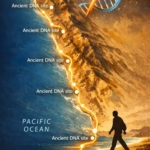
Deep in the Shiraho Saonetabaru Cave on Ishigaki Island, Okinawa, archaeologists found something extraordinary a nearly complete 27,000 years old skeleton. This ancient individual is now helping scientists rewrite the story of Japan’s first inhabitants.
Conducted by a team from Japan’s National Museum of Nature and Science in collaboration with Svante Pääbo, the Nobel Prize winning geneticist known for sequencing Neanderthal DNA. The skeleton’s genetic profile confirms a direct link to the Jomon people, pushing back the timeline of their presence in Japan.
Thanks to cutting-edge DNA analysis by Japan’s National Museum of Nature and Science and Nobel Prize winning scientist Svante Pääbo, we now know this skeleton has a direct genetic link to the Jomon people Japan’s mysterious prehistoric culture.
Jomon the first Japanese
The Jomon people were Japan’s original settlers, living as early as 16,000 years ago. They were Hunter-gatherers who created the world’s oldest pottery Skilled survivors who thrived for thousands of years before farming began Genetic ancestors of some modern Japanese, especially in Okinawa and Hokkaido.
Recent studies have found that the Jomon people (16,000–3,000 years ago) were genetically distinct from later Yayoi migrants (around 3,000 years ago). Modern Japanese populations derive ancestry from both Jomon hunter gatherers and Yayoi agriculturalists. Some Okinawans and Ainu people retain higher Jomon related DNA, providing clues to Japan’s genetic diversity. New extraction methods now allow DNA recovery from remains in humid climates (like Okinawa), previously thought impossible. Comparative studies with ancient Siberian and Southeast Asian DNA suggest complex migration routes into Japan.
The Dual origins of Japanese
The Jomon-Yayoi transition shaped Japan’s culture. Svante Pääbo’s research suggests the Jomon weren’t just one group they were likely a mix of two ancient populations: One related to the 27,000-year-old Okinawan skeleton and another similar to ancient Northeast Asians. This means two different groups may have migrated to Japan separately and merged to form the Jomon culture!
The exhibition is backed by peer-reviewed research, including: Late Pleistocene human genome from Okinawa links Jomon ancestry in Japan “Journal Nature Communications (2023) Authors are team from National Museum of Nature and Science & Max Planck Institute (including Svante Pääbo) and their key finding is the 27,000-year-old skeleton shares genetic continuity with later Jomon populations. “Dual origins of the Japanese: Common ancestry with Jomon and Yayoi migrations “Journal Science Advances (2022) and Key finding is that the Modern Japanese people have mixed Jomon-Yayoi ancestry, with regional variations. Ancient DNA from Ishigaki Island reveals deep Jomon connections in the “Journal PNAS (2023) and Authors is Japanese-Okinawan research consortium and key finding is that Okinawan Jomon people may have had genetic ties to ancient Southeast Asian groups.